LEARNING IN PRACTICE: HOW FIELD EXPERIENCE STRENGTHENS DESIGN
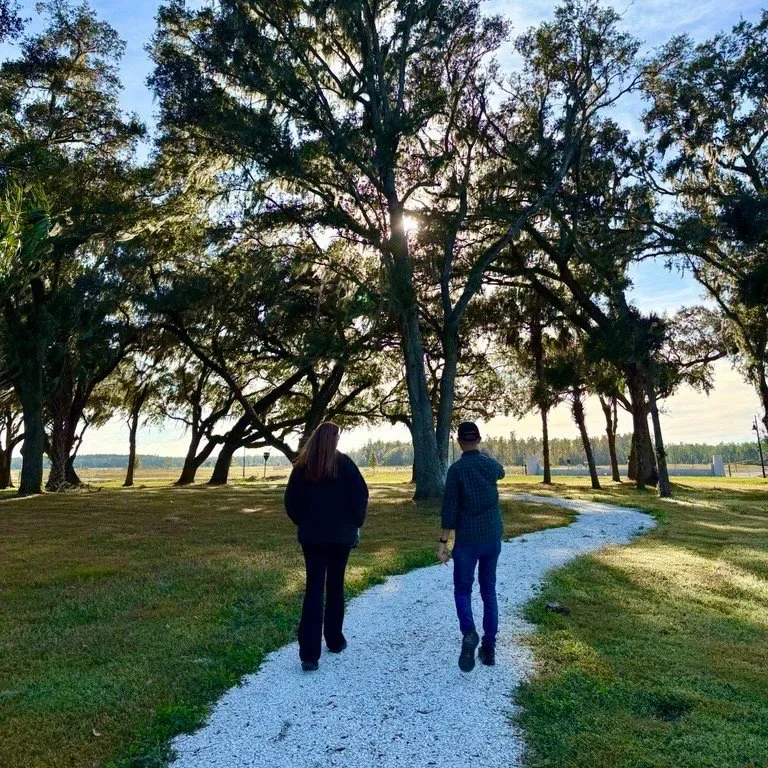
Michael and Kinsey walk along a crushed-shell path through a preserved natural oak hammock at the main gateway to The Hammock, one of the private gated communities within Two Rivers.
At ELM, professional development extends well beyond the studio. Regular site visits to active and completed projects place designers directly in the field, where construction methods, material performance, and sequencing can be observed in real time. These experiences strengthen judgment, sharpen technical awareness, and reinforce the relationship between drawings and built form.
By engaging directly with construction and installation, designers gain a clearer understanding of how ideas translate into reality—what works, what requires refinement, and how early decisions shape long-term outcomes.
A Studio That Supports Learning
Hands-on learning is reinforced by ELM’s collaborative studio structure. As a small, closely connected firm, project teams work across disciplines with direct access to experienced leadership and consistent Principal involvement. Knowledge gained in the field is brought back into the studio, shared across teams, and applied to future work.
For clients, this integration results in clear communication, continuity of vision, and a well-coordinated construction process. For the studio, it fosters a culture of mentorship and shared accountability—where learning is continuous, experience is collective, and design intent is carried with clarity from concept through execution.
Two Rivers exemplifies this approach—serving as both a complex, evolving community and a living classroom where planning, documentation, and construction converge in real time.
Two Rivers: A Living Classroom
Our work at Two Rivers, a 5,345-acre master-planned community in Pasco and Hillsborough Counties, offers an example of how our studio structure benefits both client outcomes and staff development. Now deep into the Construction Development phase, Two Rivers is a dynamic environment for continued learning—where planning ideals, technical documentation, and field execution intersect in real time.
On a recent visit to the project site, Senior Associate Michael Schiebe brought several of ELM’s landscape architecture associates to the site to observe active construction and landscape installation. These trips are invaluable: they allow staff to verify plant quantities, confirm correct installation techniques, and evaluate how designed compositions are taking shape on the ground. From these observations, Michael and the team develop formal punch lists for the contractor and Owner—ensuring high-quality execution and offering insight that will refine future drawing sets.
These site visits cultivate a deep understanding of materiality and performance. Designers experience the plant palette firsthand—how newly installed material looks and feels, how it begins to connect with surrounding species, and how these early stages shape the landscape’s long-term success. They study hardscape monument installations—both in progress and completed—examining masonry techniques, stone veneer details, and construction sequencing. They also review civil engineering operations such as roadway infrastructure installation and mass grading, seeing how the foundational layers of community development set the stage for everything that follows.
For emerging professionals, this experience is invaluable. It connects the abstract to the tangible. It helps them understand scale, craft, and complexity. And it reinforces why thorough documentation, thoughtful design, and clear communication matter so profoundly to the final outcome.
A Practice Shaped by Experience
At ELM, learning is continuous and embedded in the way we practice. Insights gained in the field inform how projects are documented, detailed, and delivered, shaping stronger work long before construction begins. Each site visit, each observation, and each lesson learned becomes part of a growing body of shared knowledge carried forward into future projects.
As communities like Two Rivers continue to take shape, they reinforce the value of learning in practice. They demonstrate how thoughtful design, informed by real-world experience, leads to places that are resilient, enduring, and deeply connected to their context. At ELM, this approach defines our work—grounded in observation, strengthened through mentorship, and guided by a commitment to shaping places that perform as well as they inspire.